Generative AI is predicted to save US legal professionals up to 240 hours a year, but it is also triggering unprecedented structural scrutiny from federal judges and state bar associations. From multi-million dollar Silicon Valley funding rounds to escalating judicial penalties for “AI hallucinations,” the American legal technology landscape is shifting faster than ever.
For corporate counsel, AmLaw 100 partners, and boutique practitioners alike, staying on top of legal AI news is no longer just an IT concern—it is a baseline requirement for ethical practice in the United States.
At a Glance: This Month in Legal AI
- Sanction Escalation: US courts have crossed a critical threshold, shifting from mild warnings to career-ending professional suspensions for unverified AI brief drafting.
- The Funding Horizon: Institutional capital is consolidating heavily behind enterprise-tier legal platforms that offer strict, ring-fenced data protection models.
- The Regulatory Frontier: The American Bar Association (ABA) has intensified enforcement of technology competence mandates under Model Rule 1.1.
Top US Legal AI Headlines
Federal Courts and State Bars Issue Career-Ending Sanctions for “AI Hallucinations”
American courts have sharply transitioned from warning lawyers about AI to actively issuing severe financial and professional penalties. Public data tracking confirms that US courts imposed over $145,000 in AI-related filing sanctions in early 2026 alone, with the total database of tracked US hallucination incidents now surpassing 800 distinct court actions.
Two landmark cases have set severe precedents for the American bar:
- The Sixth Circuit Court of Appeals (Whiting v. City of Athens, March 2026): A three-judge federal panel issued an explicit sanctions opinion addressing systemic appellate brief misconduct under Federal Rule of Appellate Procedure 38. The panel levied a $15,000 punitive fine per attorney, ordered full reimbursement of opposing counsel’s fees, and applied double costs—the stiffest penalty available—after discovering over two dozen fabricated case citations and systematic misrepresentations of the record.
- The Nebraska Supreme Court (Prososki v. Regan, March 2026): In a historic move, the Nebraska Supreme Court struck an appellant’s brief, dismissed the appeal entirely, and referred the attorney to the Counsel for Discipline. The filing attorney had submitted an appellate brief in a marital dissolution case containing 63 citations—57 of which were defective, including 20 completely hallucinated, non-existent cases. This case resulted in the first indefinite practice suspension tied directly to AI-use in U.S. history.
The Compliance Takeaway: US courts are increasingly stacking remedies. A single unverified AI filing can now trigger simultaneous Rule 11 sanctions, contempt findings, case dismissals, and immediate referrals to state disciplinary boards for lack of candor.
Silicon Valley LegalTech Funding Breaks Records
While broader venture capital has seen tightening cycles, investment in American AI-native legal technology has accelerated aggressively.
- Harvey AI crossed a staggering valuation following a massive growth round co-led by GIC and Sequoia Capital, pushing its annualized recurring revenue (ARR) past $190 million, driven by mass adoption across the AmLaw 100.
- Wordsmith recently closed a $70 million Series B to expand its agentic AI workflows specifically designed for corporate in-house legal departments.
- Ironclad and Filevine both crossed the $200 million ARR threshold, cementing contract lifecycle management (CLM) and practice intelligence as core enterprise software pillars.
How AI is Transforming the American Legal Workflow
The Evolution of Federal and Local Rules
The judicial response to AI risks is creating a complex patchwork of compliance requirements across the US. To date, more than 300 federal district judges and local state courts have enacted specific standing orders regarding generative AI. While some courts require mandatory disclosure if AI was used to draft a pleading, federal appellate bodies have indicated that existing rules (like Federal Rule of Civil Procedure 11) are already robust enough to punish unverified AI work without needing separate, tech-specific mandates.
The Realignment of the Billable Hour
Because enterprise legal AI tools can handle document review, deposition prep, and preliminary drafting in a fraction of the traditional time, the billable hour is facing structural decline in corporate America. Corporate legal departments (CLDs) are using their leverage to demand flat-fee or value-based pricing structures, forcing law firms to monetize efficiency and strategic expertise rather than hours clocked. This rapid shift highlights why navigating complex operational landscapes is central to practicing contemporary corporate law.
Critical Ethics and Privacy Mandates for US Attorneys
The ABA Model Rules on Technology Competence
Under ABA Model Rule 1.1 (Comment 8), American lawyers have a strict ethical duty to maintain technological competence. The American Bar Association’s Formal Opinion 512 explicitly outlines how generative AI interfaces with standard professional conduct rules:
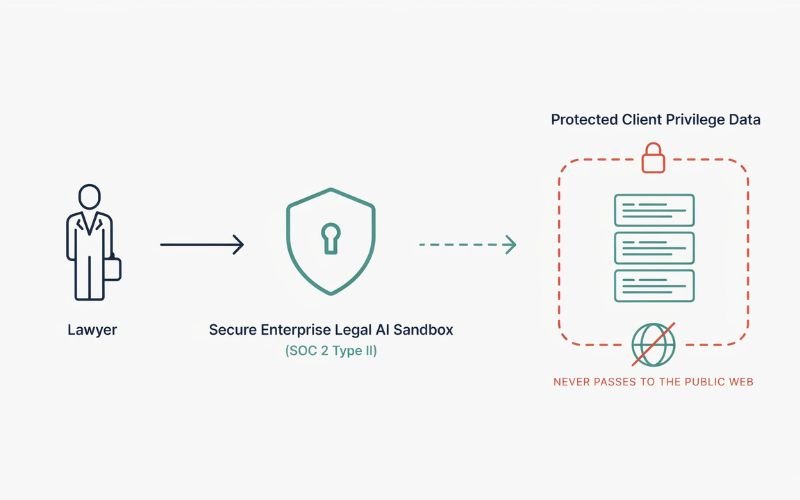
- Confidentiality (Rule 1.6): Lawyers cannot input protected client information or proprietary trade secrets into public, consumer-grade AI models where the data may be used for model training. Doing so constitutes a direct ethical breach and potentially waives attorney-client privilege.
- Supervision (Rules 5.1 and 5.3): Partners and managing attorneys have a non-delegable duty to review and verify every line of an AI-generated draft before it is signed and filed. An LLM cannot be treated as a self-verifying lawyer; it must be supervised with the same critical skepticism applied to a junior associate or a third-party vendor.
Top AI Tools Dominating the US Legal Market
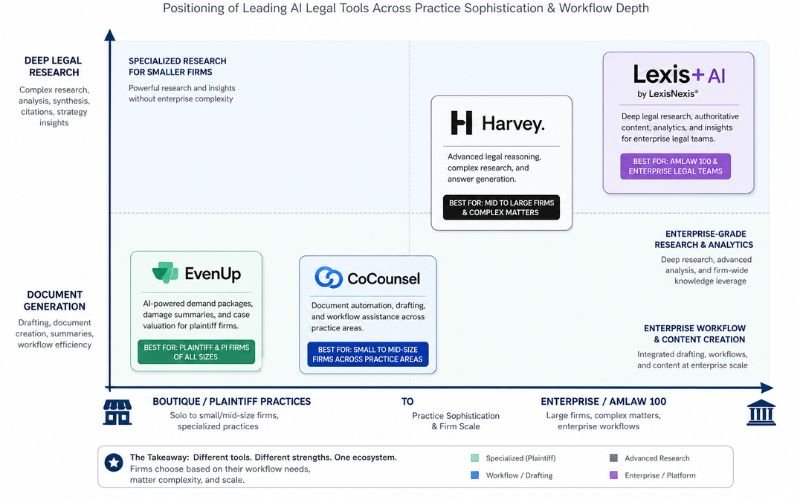
| Tool | Core Strength | Primary US Target Market |
| CoCounsel (Thomson Reuters) | Secure, hallucination-free research & deposition prep | Broad market (Boutiques to Enterprise) |
| Harvey AI | Tailored firm-wide AI workspaces and custom LLM integrations | AmLaw 100 & elite corporate teams |
| Lexis+ AI | Conversational research linked to verified American case law | All US litigation and transactional practices |
| EvenUp | Claims intelligence and document generation | Personal Injury & plaintiff-side firms |
Future Outlook: The Rise of Agentic AI
Over the next 12 to 24 months, the US legal sector will shift from conversational AI “chatbots” to agentic AI. Rather than just summarizing a document, legal AI agents will be deployed to independently execute complex, multi-step workflows. For example, an agent could autonomously track a new federal regulatory update, identify every active corporate contract impacted by that change, draft custom compliance amendments tailored to each state’s jurisdiction, and queue them for final attorney review.
Frequently Asked Questions (FAQs)
Are US lawyers required to disclose if they use AI?
It depends entirely on the jurisdiction. Over 300 federal and state judges have issued individual standing orders requiring disclosure or certification of human verification. Always check the specific local rules of the district court or state circuit where you are filing.
Can an AI tool be listed as a patent inventor under US law?
No. The US Patent and Trademark Office (USPTO) and federal courts have consistently ruled that under current US patent law, inventors must be natural human beings. AI can be used as a tool in the inventive process, but the system itself cannot hold patent rights.
How do enterprise legal AI tools avoid data privacy issues?
Enterprise-grade legal tech platforms protect attorney-client privilege by operating within secure, isolated cloud environments. They sign Business Associate Agreements (BAAs), guarantee SOC 2 Type II compliance, and contractually ensure that client data is completely ring-fenced and never used to train foundational AI models.